
Evolve
Project-based development or monthly capacity: how to decide
Hiring development as a fixed project or on a monthly capacity basis is not a matter of price, but of how well you know today what you need. This guide compares both modalities according to scope, uncertainty, continuity and ways to prioritize, without addressing rates or contracts.
In this guide
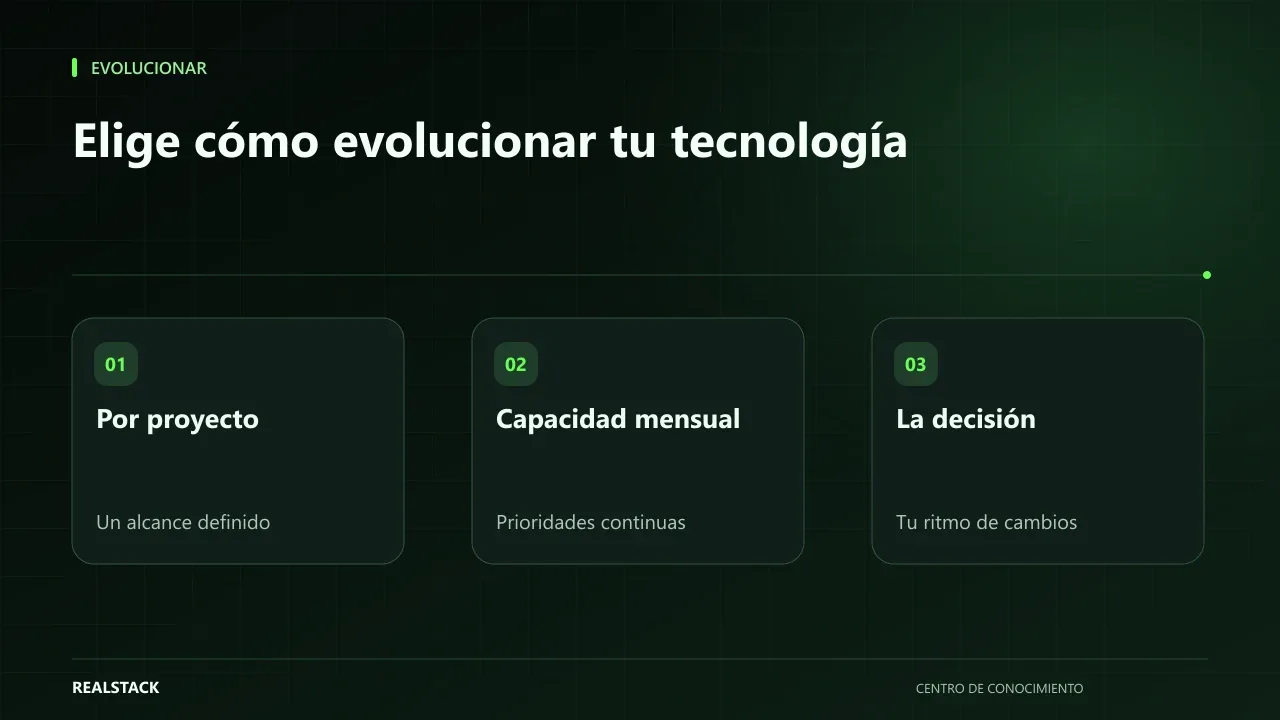
The right question
“How much does it cost?” may seem like the first question, but the one that determines the modality is different: how well do you know what you need? If you can describe the result in detail and it is unlikely to change, a fixed project makes sense. If you know the problem but not the solution, or the work is ongoing, a monthly capacity engagement usually fits better.
The two modalities
| Aspect | Fixed project | Monthly capacity |
|---|---|---|
| Scope | Defined in writing before starting | Prioritized periodically within a cap |
| Changes | Require change control | Reordered in the next prioritization |
| End | Delivery and acceptance | Continues while there is work and agreement |
| Main risk | Poorly defined scope or uncontrolled growth | Work without direction or without measuring progress |
| Fits with | A concrete, stable result | Continuous improvement, many small needs, uncertainty |
Signals to choose a project
- You can write clear acceptance criteria.
- Business rules are defined and won’t change soon.
- There is a date or milestone that matters.
- The work ends: after that there is only maintenance.
Signals to choose monthly capacity
- You have a list of improvements that changes with the business.
- You need to experiment before deciding the final solution.
- There are systems in use that require continuous attention.
- You prefer to prioritize each month based on results.
The limits of each
A fixed project loses sense when the scope is discovered along the way: every change becomes a negotiation and the scope grows out of control, which Atlassian describes as “scope creep.” A monthly capacity arrangement loses sense when no one prioritizes: hours are spent on the urgent and not the important. In both cases, the solution is the same discipline: written scope, clear priorities and verifiable acceptance.
Mixing is valid
Many companies start with a project to build the foundation and then switch to a monthly capacity to evolve it. The reverse is also possible: use monthly capacity to discover what is needed and then close a project. What matters is that each phase has its own rules.
Decision procedure
- Describe the problem and the expected outcome.
- Answer the downloadable decision guide.
- If most answers point to certainty, prepare a fixed scope.
- If they point to uncertainty or continuity, define how capacity will be prioritized and measured.
- Before signing, review the conditions of the chosen modality with your provider and, if applicable, with your advisor.
Applied example
How to use the downloadable guide
- Answer the eight questions with your team.
- Count which modality they point to.
- Review the “Before deciding” list.
- Bring the result to the conversation with your provider.
Decision criteria in detail
| Aspect | Project | Monthly capacity |
|---|---|---|
| Scope | Closed and defined at the start | Prioritized period by period |
| Certainty | High about what is needed | Low or changing |
| Budget control | Price or range per scope | Known monthly spending |
| Change management | Each change is evaluated and approved | Changes enter the next prioritization |
| Main risk | Poorly defined scope | Lack of prioritization and follow-up |
Complete concise example
Concise example. A fictional company needs two things: a portal for its distributors to download datasheets and continuous improvements to its internal ordering system.
The portal has clear users, pages and permissions: they hire it as a project, with scope, acceptance criteria and exclusions. The improvements to the ordering system change every month according to what the commercial area requests: they hire those as monthly capacity, with a prioritization meeting every two weeks and a monthly report of what was delivered.
By separating the two needs, they avoid adding unforeseen improvements into the portal project and avoid paying monthly capacity for something that had a closed scope. Invented example.
Common mistakes, explained
Choosing a project when you don’t know what you need leads to constant changes and scope discussions. Choosing monthly capacity without someone on your side to prioritize leads to paying for hours without direction. In both cases, the modality does not replace management: someone from your company must decide what to do and verify what is delivered.
How to know if it worked
- You know why you chose each modality.
- There is someone from your company who prioritizes and verifies.
- You review results each month or at each delivery.
Plan for the first four weeks
- Week 1: describe needs and certainty.
- Week 2: answer the decision guide.
- Week 3: talk with the provider about conditions.
- Week 4: define how you will measure progress.
Diagnosis before starting
- Write what you need and how sure you are about it.
- Review how many changes your last project had.
- Identify who in your company can prioritize each month.
| If your case is… | Do this |
|---|---|
| You need something new and well defined | Project. |
| You need continuous improvements without a closed list | Monthly capacity. |
| You need both things | Separate them into two agreements. |
A second example, in contrast
Concise example. A fictional company hires monthly capacity to build a new application, thinking this will give them flexibility. Without someone to prioritize, the hours are used on minor adjustments. They switch to a fixed project with closed scope for the first version and keep monthly capacity for later. Unlike the first example, the initial modality was wrong. Invented example.
What to do when something fails
- If changes overwhelm a project, pause and reestimate the scope.
- If monthly capacity does not show progress, review prioritization.
- If you change modality, document the state of the work.
How to measure it with your own data
- For a project: compare the agreed dates and scope with what was delivered.
- For monthly capacity: review what was delivered each month against what was prioritized.
- Count the changes requested and their effect on schedule.
- Record how many decisions remained waiting on your company.
With those records you can evaluate whether the chosen modality remains appropriate. If changes in a project don’t stop, you may have needed monthly capacity. If in monthly capacity the prioritized items are never completed, perhaps someone to prioritize is missing or the work should have been closed as a project.
Frequent mistakes
- Hiring a fixed project with a one-page vague scope.
- Hiring monthly capacity without someone to prioritize.
- Not measuring what was delivered each month.
- Treating scope changes as if they were part of the original project.
Checklist
- Problem and outcome described.
- Level of certainty evaluated.
- Prioritization method defined.
- Progress measurement method defined.
- Conditions reviewed with the provider.
Bring it to your business
Work Mode Decision Guide
Markdown decision guide with questions about scope, uncertainty, continuity and prioritization to help choose between fixed-price project development and monthly capacity. It does not modify contracts or rates.
View resourceWhich is cheaper?
It depends on the case. A fixed project with a poorly defined scope can end up more expensive due to changes; a capacity engagement without direction can spend hours without results. Compare according to your level of certainty.
Does this guide change my current contract?
No. It is a guide to think through the decision. The conditions of your service are those in your existing contract or plan.
Can I change modality later?
Yes; review the termination and transition conditions of each agreement.
What should I ask about monthly capacity?
How prioritization is done, what happens with unused hours, how deliveries are reported and how the engagement is terminated.
Who in my company should prioritize monthly capacity?
Someone who knows the needs of the areas and has the authority to say what they expect. Without that person, hours are allocated to whoever shouts loudest, not to what contributes most.
How do I prevent a project from becoming endless?
Close the scope in writing, record each change with its effect on schedule and price, and leave new improvements for a later phase instead of adding them to the ongoing project.
Keep exploring
Evolve
How to build a 90-day technology roadmap
A 90-day roadmap is not a wish list with dates: it is a decision about what to do first with the capacity you actually have. This guide explains how to define goals, prioritize, map dependencies, estimate capacity, and review the plan each month.
Evolve
How to identify technical debt that is already affecting the business
Technical debt is not just a developers' problem: it becomes a business problem when every change takes longer, errors recur, or no one dares to update. This guide explains how to recognize symptoms, gather evidence, estimate risk and prioritize, without diagnosing blindly.