
Launch and sell
B2B catalog, online store or corporate website: which does your company need
Many B2B companies ask for “a website” when what they really need is to solve how they price, how they sell and which inventory they show. This guide compares B2B catalog, online store and corporate website based on how your customer buys, and provides a matrix to decide with your team before requesting proposals.
In this guide
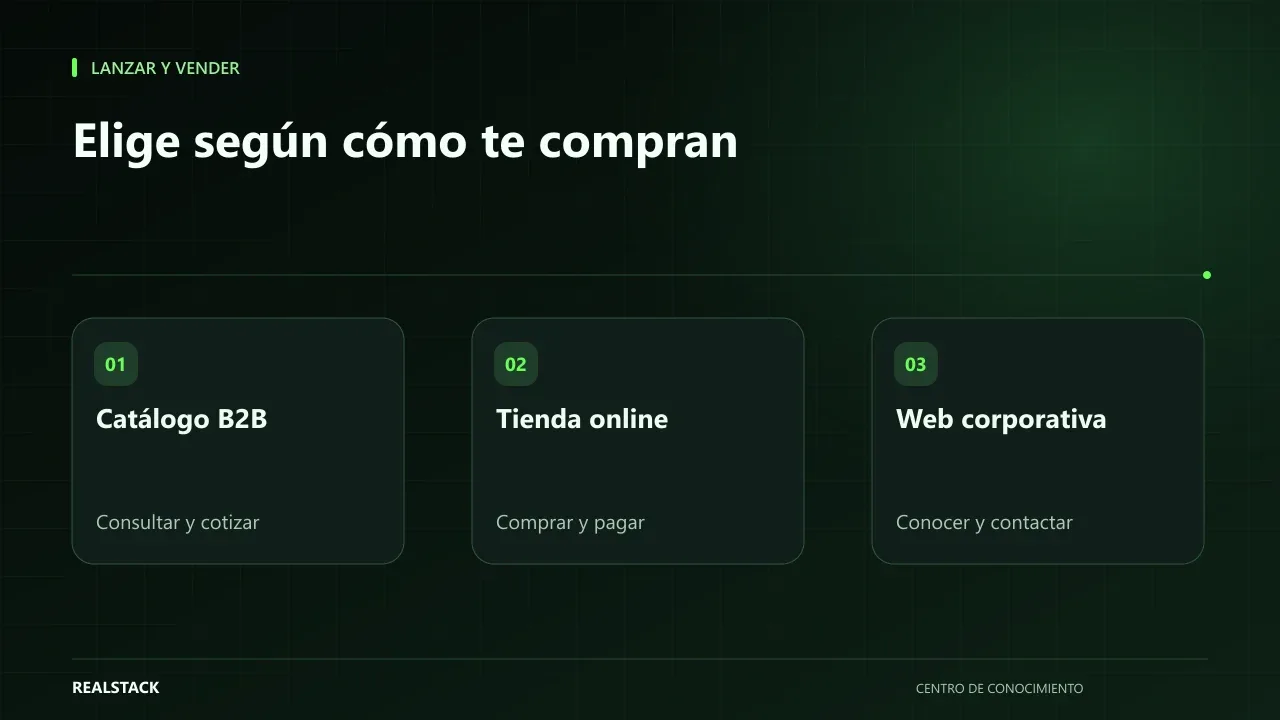
Start from how they buy you, not from the type of site
An industrial spare parts distributor that receives orders by email, a manufacturer that quotes every project and a brand that sells products at fixed price can all ask for exactly the same thing: “we need a website.” But each one needs something different. If you choose the format based on preference or what competitors have, you end up with a shop no one uses to buy or a catalog that forces your team to answer by hand what the site could solve.
The right decision comes from three questions about your operation: is the price fixed or does it depend on volume, customer or specification? Can your customer buy alone or do they need an advisor? Does your inventory change so much that showing it incorrectly costs you more than not showing it?
What each format solves
| Format | What it’s for | Fits when | Falls short when |
|---|---|---|---|
| Corporate website | Present the company, its capabilities and open a conversation | You sell services or projects and the decision depends on trust and references | Your customers are looking for a specific product and cannot find it |
| B2B catalog | Show products with technical datasheets and lead to a quotation | You have many SKUs, the price depends on the customer or volume and you issue quotes | Your customers want to pay online without speaking to anyone |
| Online store | Sell with price, cart, payment and shipping | The price is public, the product is self-explanatory and you can ship without negotiating | Each order requires negotiation or technical validation |
The boundaries are not rigid. A catalog can have some products available for direct purchase and a store can include a “request a quote” section for large orders. The important thing is to know the main path and design the site around it.
Diagnosis: five signals from your operation
- Price: if your price list changes by customer, by volume or by exchange rate, publishing it in a store forces you to maintain rules that today live in the heads of your commercial team.
- Specification: if your customer needs to confirm compatibility, standard or application before buying, the technical datasheet weighs more than the payment button.
- Inventory: if real stock lives in a system the site cannot read, showing availability online can generate sales you cannot fulfill.
- Purchase cycle: if weeks pass between the first inquiry and the purchase order, the site must capture the inquiry well, not close the sale.
- Team: if whoever answers WhatsApp is already saturated, a format that generates more unfiltered inquiries makes the problem worse.
How to decide step by step
Procedure
- Write in one sentence how your typical customer buys today, from finding you to paying.
- Mark which parts of that journey need a person and which could be solved automatically.
- Review your products: how many SKUs you have, how many have a complete datasheet and how many have a fixed price.
- Rate each format with the matrix in this guide, using data from your operation and not assumptions.
- Choose the main path and note which exceptions you will handle outside the site.
- Define what must happen after the click: who responds, on which channel and with what information.
Applied example
If you want to see a real case of an industrial catalog closed via WhatsApp, review the Petrogrease case published by RealStack. Its figures correspond to that case and period; do not extrapolate them to your company.
What changes operationally with each format
A corporate website requires little content maintenance, but needs case studies, capabilities and a clear contact channel. A catalog requires discipline with datasheets: each new product without a complete datasheet is one more inquiry for your team. A store requires that prices, inventory, payments, shipping and returns work every day, because the customer no longer speaks with you before buying.
That is why it is also worth choosing according to the capacity of who will operate the site after launch, not only according to the launch itself.
Limits of this guide
The matrix helps you organize the decision; it does not replace a review of your operation or the technical definition of integrations with your inventory or billing. If your case mixes several sales models, it is normal that the answer is a main format with exceptions.
Decision criteria in detail
| If in your operation… | Usually fits better | Why |
|---|---|---|
| Price depends on volume, customer or negotiation | Catalog with request for quotation | Publishing a fixed price forces you to maintain rules that the store does not handle well without additional development |
| You sell standard SKUs with public price and known shipping | Online store | The customer can buy without speaking to anyone and the payment is recorded |
| What you sell is a service or a project | Corporate website with forms and case studies | The buyer needs trust and context before requesting a meeting |
| Inventory changes daily and is not in any system | Catalog without published stock levels | Showing outdated stock generates complaints |
| You have both realities: recurring customers and new buyers | Catalog now, store in phases later | Allows validating which products are bought without an advisor before enabling payments |
No single criterion decides alone. If three or more answers point to the same format, you have a good hypothesis to request proposals. If responses are spread out, the mixed phased format is usually the most prudent decision, because it lets you learn from the real behavior of your buyers before investing in payments, logistics and inventory online.
Complete synthetic example
Synthetic example. A fictional distributor of power tools sells to hardware stores and construction companies. Hardware stores buy known SKUs at list price; construction companies request volume discounts and payment terms.
Filling the matrix, the company marks that 60% of its orders are from hardware stores at list price, that inventory lives in an ERP that exports stock each night and that construction companies always negotiate. The conclusion is not to choose one of the formats, but two journeys: a catalog with quotation requests for construction companies and, in a second phase, direct purchase for a closed group of high-turnover SKUs.
Before requesting proposals, the company writes on a page what the buyer would do in each journey, what data the site needs (prices, stock, datasheets) and who responds to quotations. That page is what it hands to suppliers. All figures and the company are fictional.
How to use the downloadable matrix
- Download the matrix and fill one row per criterion with the real situation of your company, not the desired one.
- Ask sales and operations to fill it separately; differences reveal assumptions nobody had discussed.
- Mark in the result column which format each criterion suggests.
- Count the matches and write a hypothesis in one sentence.
- Attach the matrix to your request for proposal so providers respond to your reality and not to a template.
Common mistakes
- Choosing an online store because “everyone sells online,” with prices that are actually negotiated.
- Publishing a catalog without technical datasheets and expecting the customer to request a quote anyway.
- Showing inventory that is not connected to the real stock.
- Designing the site without deciding who responds to inquiries and in what timeframe.
- Copying a competitor’s structure without knowing whether their sales model is yours.
Checklist before requesting proposals
- I have written how my typical customer buys today.
- I know which products have fixed prices and which are quoted.
- I know how many SKUs have a complete datasheet.
- I have defined who responds to inquiries that arrive through the site.
- I filled the matrix with my commercial team.
- I noted the exceptions the site will not handle.
Bring it to your business
Matrix to choose between catalog, store and corporate website
Matrix to compare B2B catalog, online store and corporate website using criteria from your own operations: price, specification, inventory, purchase cycle and team capacity. Useful to decide together with sales before requesting proposals.
View resourceCan I start with a catalog and later move to a store?
Yes, and it is often a prudent way to advance when price is still negotiated. The important thing is that datasheets and family structure are well done from the start, because they are the foundation of any future store.
Does a B2B catalog need to show prices?
Not necessarily. If the price depends on the customer or volume, the datasheet can lead to a quotation. If some products have stable pricing, you can show it only for those.
Which format ranks better on Google?
None by itself. Google recommends useful content made for people; in a catalog that translates to complete, well-organized datasheets. No format guarantees rankings.
Can I start with a catalog and later move to a store?
Yes, and it is a common path. From the start, request that datasheets and family structure be prepared so prices and payments can be added later.
Keep exploring
Launch and sell
How to prepare content, domain and access before starting your project
Much of a web project's delay isn't development but waiting for texts, photos, logos and access. This guide shows how to prepare content, domain and access before starting, who should own each account and how to deliver them without sharing passwords over chat.
Launch and sell
What a proposal to build your website or store should include
A proposal to build your website or store should make clear what you get, what is not included, what you must deliver, how success will be measured and what happens after delivery. This guide helps you read it with a business perspective, without turning it into a legal review.