
Launch and sell
What a proposal to build your website or store should include
A proposal to build your website or store should make clear what you get, what is not included, what you must deliver, how success will be measured and what happens after delivery. This guide helps you read it with a business perspective, without turning it into a legal review.
In this guide
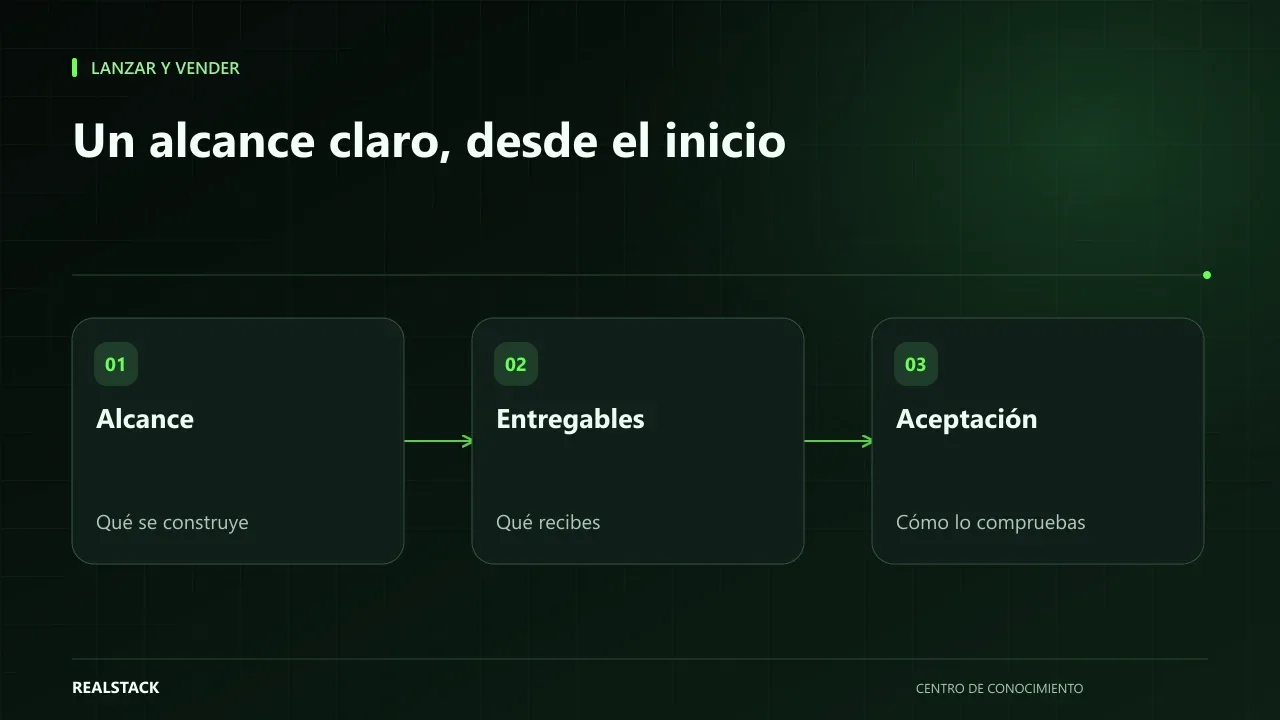
The problem appears after signing
Almost no web project becomes complicated in the first meeting. It gets complicated in the third week, when someone asks whether the form included the CRM connection, whether the supplier would take the photos, or whether the blog came with articles. Each of those questions has an answer, and ideally it should be written in the proposal before you approve it.
Reading a proposal carefully does not require knowing how to code. It requires checking six blocks with the same question: is this written down or am I assuming it?
The six blocks you should find
| Block | What it should say | Warning sign |
|---|---|---|
| Scope | Which pages, features and content are built | “Complete site” without a list |
| Deliverables | What you receive and in what form: published site, access credentials, documentation | No mention of access or documentation |
| Exclusions | What is not included and how it is priced | No exclusions section |
| Inputs and access | What you must deliver and by when | Deadlines that don’t depend on your inputs |
| Measurement | What will be measured from launch and who has access | Analytics “to be defined” |
| Continuity | What happens after delivery: warranty, support, hosting, evolution | Everything mixed together as “support” |
Scope and deliverables
Good scope is a list, not an adjective. It should state how many pages or templates, which features, which integrations and which languages. Deliverables answer another question: what you will have in hand at the end. Besides the published site, request that administration access be delivered in your company’s name and a way to understand what was built.
Exclusions: the section that prevents most disputes
A proposal that does not say what it excludes leaves everything open to interpretation. Typical exclusions are content writing, photography, third-party licenses, ad spend, integrations not listed and design changes after approval. Something being excluded is not bad: the problem is discovering it late.
Inputs, access and deadlines
Every deadline depends on something you deliver: texts, logos, photos, domain access. A serious proposal states when the clock starts and what stops it. At RealStack, for example, the 72 h* timeframe for Launch™, Commerce™ and Scale™ begins with onboarding approval, with a standard scope closed in writing and complete inputs; it does not start from payment and does not apply to any development.
Measurement and continuity
Ask what will be measured on launch day and with which tools. Analytics accounts should be in your company’s name, with provider access granted as a user, not the other way around.
Under continuity there are four distinct things you should not mix: warranty (bug fixes to the delivered work for a defined time), hosting and infrastructure (keeping the site online), support (who handles requests and under what plan) and evolution (improvements and new features, which are quoted separately). If the proposal groups them with a single word, ask that they be separated.
Review procedure
- Read the entire proposal once without marking anything.
- On the second reading, locate the six blocks and mark which are missing.
- Make a list of what you are assuming and what is not written.
- Send those questions to the provider in writing and request an adjusted version.
- Compare the final version with the downloadable checklist before approving.
Applied example
Limits of this guide
This guide helps you review the commercial and operational content of a proposal. It is not legal or tax advice: clauses on liability, intellectual property, taxes and payment terms should be reviewed by your lawyer or accountant.
Criteria for comparing proposals
| Aspect | Weak proposal | Reviewable proposal |
|---|---|---|
| Scope | “Modern responsive website” | List of pages, templates and features with their behavior |
| Deliverables | “Working site” | Published site, access delivered, documentation and training described |
| Exclusions | Not listed | Explicit list of what is not included |
| Inputs | Not mentioned | What your company delivers, in what format and when |
| Deadlines | Fixed date without conditions | Date conditioned on inputs and approvals |
| Measurement | Not present | What is measured, with which tool and who owns the account |
| Continuity | Not present | What happens after delivery and under which conditions |
Two proposals with the same price can contain very different scopes. Comparing them by price without normalizing scope leads to choosing the one that explains the least, not the one that is most suitable.
Complete concise example
Concise example. A fictitious company receives three proposals for its corporate site. It uses the checklist and finds that proposal A details eight templates, exclusions and delivery conditions; B promises “everything necessary” without a list; C includes content writing, but does not state who owns the domain or analytics.
Instead of discarding B and C, it sends the same questions to all three providers: which templates are included, what is excluded, who creates and administers the accounts, what happens at the end. With written answers, the three proposals can be compared equally. The company chooses the provider that best responds, not the cheapest one. Invented example.
How to use the downloadable checklist
- Print or copy one checklist per proposal.
- Mark only what is written in the proposal, not what was said in the meeting.
- Turn each empty checkbox into a question for the provider.
- Request the answers in writing and annex them to the proposal.
- If there are contractual doubts, consult your legal advisor: this checklist is not legal advice.
Questions to ask the provider
- What happens if inputs arrive late: does the deadline move or does the price change?
- How many rounds of revisions does each deliverable include and what counts as a revision?
- Who creates the domain, hosting and analytics accounts, and in whose name are they registered?
- What documentation and training will my team receive at closeout?
- What post-delivery services do you offer and how are they contracted separately?
Pre-start diagnosis
- Gather all proposals received and the emails or chats where something was negotiated.
- Write down what you expect to have at the end of the project in a list of no more than ten lines.
- Identify who will sign and who will review the deliverables.
| If your case is… | Do this |
|---|---|
| You received a single proposal | Request at least one more to have a comparison, or review the only one with the checklist before negotiating. |
| Proposals differ greatly in price | Normalize scope with the same questions before comparing prices. |
| The provider does not respond in writing | Treat it as a risk signal and document what was discussed in an email from you. |
Signals that it works or not
- Good signal: you can explain in one sentence what is included and what is not.
- Bad signal: the answer to your questions is “we’ll see that later.”
- Measure it yourself: count how many boxes remained empty after the written answers.
A second contrasting example
Concise example. A fictitious company receives a single, very detailed proposal from a recommended provider. Since it has nothing to compare it to, it uses the checklist as a reference: everything is covered except continuity. Instead of seeking another provider, it requests that an annex be added about what happens after delivery. Unlike the first example, here the problem was not the scope, but what came afterward. Invented example.
What to do when something fails
- If, upon review, something is missing from what was delivered, compare it with the written scope and communicate it in writing with the exact point.
- If the disagreement concerns something that was not written, negotiate it as a change, not as a breach.
- If the relationship breaks down, first secure the domain, access credentials and copies.
Common mistakes
- Approving based on price without comparing equivalent scopes.
- Accepting “support included” without knowing what it covers or for how long.
- Not requesting access credentials in the company’s name.
- Assuming content and photos are included.
- Leaving measurement until after launch.
Checklist
- The scope lists pages or functionalities.
- There is a list of exclusions.
- Inputs are defined and who delivers them is specified.
- Deadlines state when they start running.
- Domain, hosting and analytics accounts are in your company’s name.
- It is clear what happens after delivery.
Bring it to your business
Checklist to Review a Web Proposal
A Markdown checklist to review a web development or online store proposal before approving it: scope, deliverables, exclusions, inputs and access, measurement, and continuity. Helps turn assumptions into written questions.
View resourceWhat is the difference between warranty and support?
Warranty fixes errors in the delivered work during a defined period. Support handles requests under a contracted plan. A clear proposal separates them and states how long each lasts.
Should I ask for the source code?
It depends on the platform and the contract. What must not be missing is that the domain, accounts and data are in your company’s name. Matters regarding code ownership should be reviewed with your lawyer.
Keep exploring
Launch and sell
B2B catalog, online store or corporate website: which does your company need
Many B2B companies ask for “a website” when what they really need is to solve how they price, how they sell and which inventory they show. This guide compares B2B catalog, online store and corporate website based on how your customer buys, and provides a matrix to decide with your team before requesting proposals.
Launch and sell
How to prepare content, domain and access before starting your project
Much of a web project's delay isn't development but waiting for texts, photos, logos and access. This guide shows how to prepare content, domain and access before starting, who should own each account and how to deliver them without sharing passwords over chat.