
Launch and sell
WordPress, Shopify or custom development: how to choose
Choosing between WordPress, Shopify or custom development is not a question of technical preference but of operation: what you will sell, which systems you must connect, who maintains the platform and how fast your business changes. This guide gives you criteria to compare without seeking a universal platform.
In this guide
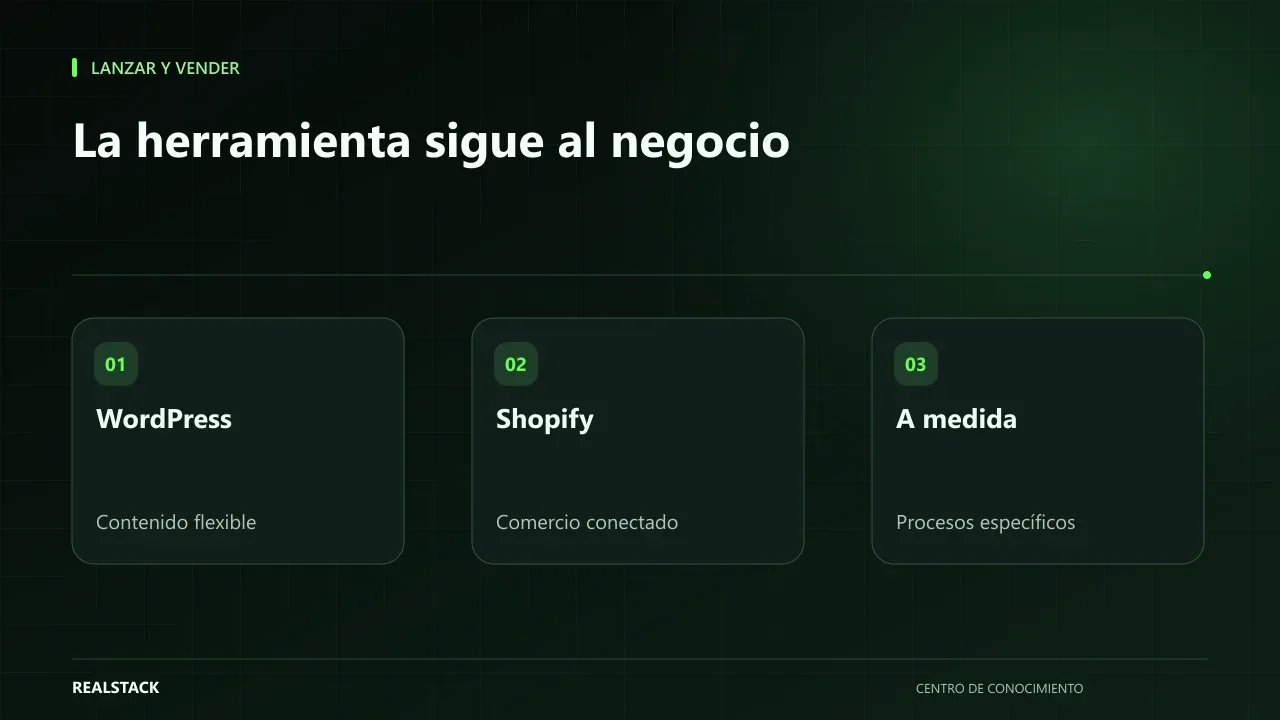
The question is not which is better
Every time someone asks which platform is best, they get passionate and contradictory answers. The reason is simple: all three options work, but for different jobs. The right question is which one requires less effort from your company to do what you need today and what you'll likely need in two years.
What each option is in business terms
- WordPress is free software that you install on hosting you choose. It gives you control and a huge ecosystem of themes and plugins, in exchange for someone keeping the core, plugins and server updated.
- Shopify is a subscription commerce platform: Shopify operates the infrastructure and you pay a plan plus the apps you add. It reduces the store’s technical work and asks you to adapt to its model.
- Custom development, for example with a framework like Next.js, is built for your case. It allows rules, integrations and experiences that don't fit in a standard platform, and requires a team to maintain and evolve it.
At RealStack these three routes correspond to Launch™ (corporate site on WordPress), Commerce™ (ecommerce on Shopify) and Scale™ (high-performance platform or site on Next.js). Product names don't change the decision logic: your operation comes first.
Five criteria to compare
| Criterion | Question you must answer | What to look at |
|---|---|---|
| Operation | Will you sell online, quote or inform? | Cart, payments, shipping, catalogs, forms |
| Integrations | Which systems must the site talk to? | Inventory, billing, CRM, WhatsApp, ERP |
| Ownership | What do you control and what does the provider control? | Domain, code, data, export, accounts |
| Maintenance | Who updates it and how often? | Versions, plugins, apps, security |
| Evolution | How often will your business rules change? | New lines, per-customer pricing, portals |
How each criterion weighs
Operation. If you will sell with a cart and payments, Shopify solves much of the operational part from day one. If your site presents the company and opens conversations, WordPress is usually sufficient. If you need custom logic, such as per-customer pricing with approval or a portal for distributors, custom development becomes sensible.
Integrations. Check whether the integration you need exists and is maintained, in the app store or plugin directory. A critical integration that depends on an abandoned extension is a risk.
Ownership. In any option, the domain and accounts should be in your company's name. On a subscription platform, find out what data you can export and in what format.
Maintenance. WordPress requires updating core, theme, plugins and the server PHP version. Shopify updates the platform, but apps and customizations remain your responsibility. Custom development needs dependencies kept current and someone familiar with the code.
Evolution. If your business changes little, a standard platform gives stability. If it changes a lot, the cost of forcing a platform to do things it doesn't support can exceed building it properly.
Suggested procedure
- List what the site must do on day one and what it should do in two years.
- Write down the systems it must connect to and who manages them.
- Score the three options with the evaluation matrix, criterion by criterion.
- Ask each provider to explain how they solve your three highest-weight criteria.
- Ask who will maintain the platform after delivery and what the scope will be.
Applied example
Limits and costs often forgotten
This guide does not compare prices. Platform plans change and should be checked on their official pages. Keep in mind total cost includes subscriptions, apps, hosting, licenses and the time of whoever maintains it. None of those items should be assumed included if the proposal does not name them.
Decision criteria in detail
| Criterion | Signal in favor of a standard platform | Signal in favor of custom development |
|---|---|---|
| Operation | Your sales process is similar to many companies | Your process has rules no platform solves without forcing it |
| Integrations | You use systems with known connectors | You need to connect internal systems without connectors |
| Ownership | Controlling content and exportable data is enough | You need to control code, deployment and infrastructure |
| Maintenance | You prefer managed updates or a large ecosystem | You have or will hire a permanent technical team |
| Evolution | Planned changes fit existing extensions | You foresee proprietary features that will be your differentiator |
WordPress, Shopify and Next.js do not compete on the same plane: the first is a content manager with a huge extension ecosystem, the second a managed commerce platform and the third a framework to build custom applications. Therefore, the useful comparison is not features but how closely your operation resembles what each solves without forcing it.
Complete synthetic example
Synthetic example. A fictional agricultural parts company evaluates the three options. It scores each criterion from 1 to 3 according to its weight: operation 3, integrations 3, ownership 2, maintenance 2, evolution 1.
Its operation is a store with public prices and national shipping, which favors a commerce platform. But it needs to read stock from a local ERP without an available connector. The company does not conclude “custom” immediately: it first asks if the ERP can export a periodic file that an app or light integration could read. Since it can, the standard platform remains viable with a bounded integration.
The matrix result is not an absolute winner but a documented decision: commerce platform, file-based integration, review in six months. The entire example is fictional.
How to use the downloadable matrix
- Assign a weight of 1 to 3 to each criterion before looking at the options.
- Rate each option per criterion with evidence: documentation, demos or written responses from the provider.
- Note in “Assumptions” what you couldn't verify.
- Multiply weight by score by hand or in your spreadsheet; the file contains no formulas.
- Review with your team the criteria where options are close: that's where the real decision lies.
Common mistakes
- Choosing the platform the provider knows rather than the one suited to your operation.
- Installing dozens of plugins or apps without knowing who will update them.
- Leaving the domain or platform account in someone else’s name.
- Requesting custom development for something a standard platform already solves.
- Forcing a standard platform to meet unsupported rules with patches.
Checklist
- Know whether my site sells, quotes or informs.
- I have the list of integrations and their responsible owner.
- I know who will own the domain, the account and the data.
- I know who will maintain the platform after delivery.
- I scored the three options with the matrix.
Bring it to your business
Platform Evaluation Matrix
CSV matrix to evaluate WordPress, Shopify, and custom development using your company's criteria: operations, integrations, ownership, maintenance, and evolution. Helps you compare proposals in an organized way and spot where an option falls short.
View resourceIs WordPress suitable for selling online?
It can with ecommerce extensions, but that adds pieces someone must maintain. If online selling is the core of the business, compare that route with a dedicated commerce platform using the same criteria.
Is custom development always more expensive?
It usually requires higher initial investment and a team to maintain it. It can be more cost-effective when alternatives force you to pay for many extensions or work with patches to meet your rules.
Will a standard platform limit me forever?
Not necessarily. Many companies start on a platform and migrate when the operation justifies it. The important thing is that your data can be exported.
Keep exploring
Launch and sell
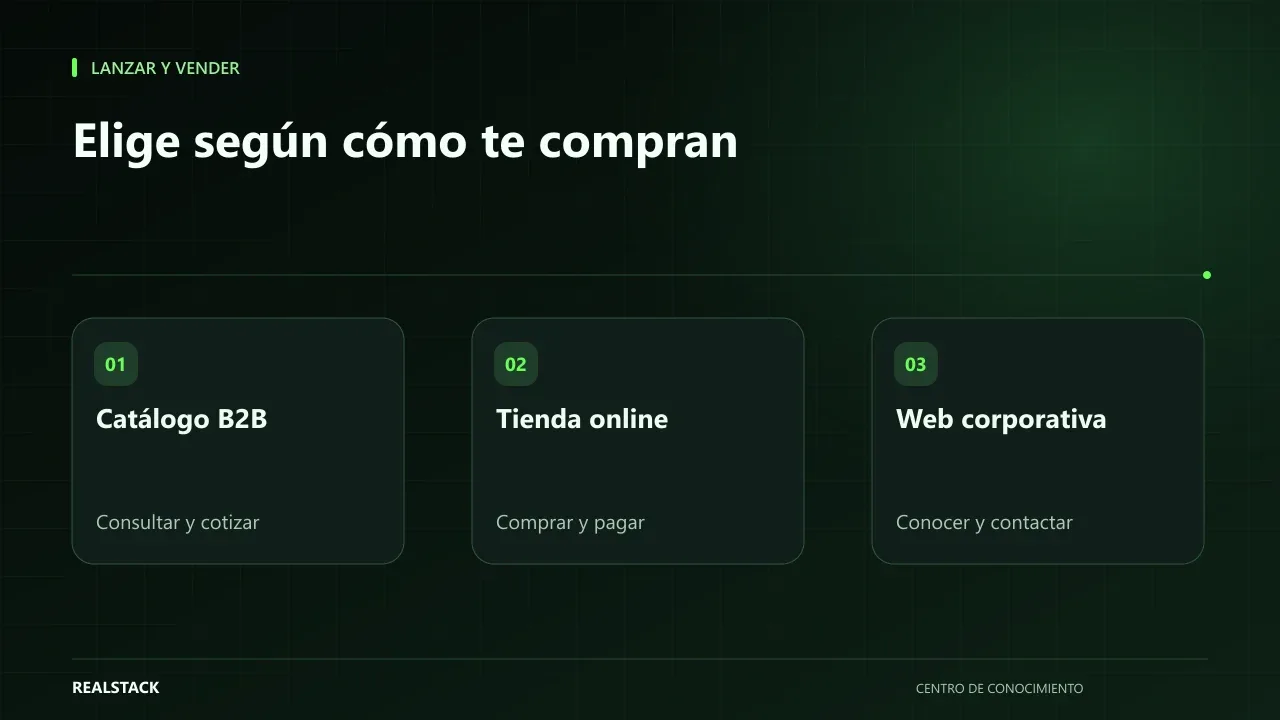
B2B catalog, online store or corporate website: which does your company need
Many B2B companies ask for “a website” when what they really need is to solve how they price, how they sell and which inventory they show. This guide compares B2B catalog, online store and corporate website based on how your customer buys, and provides a matrix to decide with your team before requesting proposals.
Launch and sell
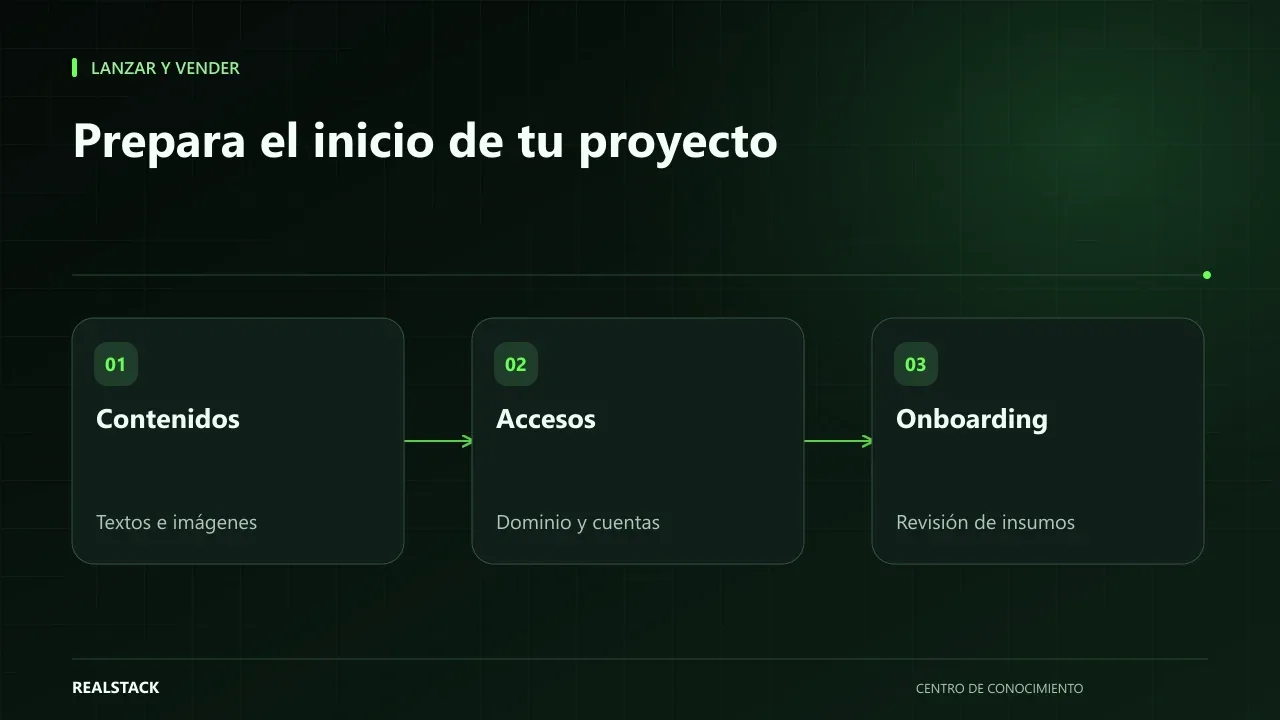
How to prepare content, domain and access before starting your project
Much of a web project's delay isn't development but waiting for texts, photos, logos and access. This guide shows how to prepare content, domain and access before starting, who should own each account and how to deliver them without sharing passwords over chat.